STAGES Decodables by Aligned
-
 Interactive Reproducible Decodable Readers$48.00
 -
 STAGES Four Pack of Stages Books$45.00
 -
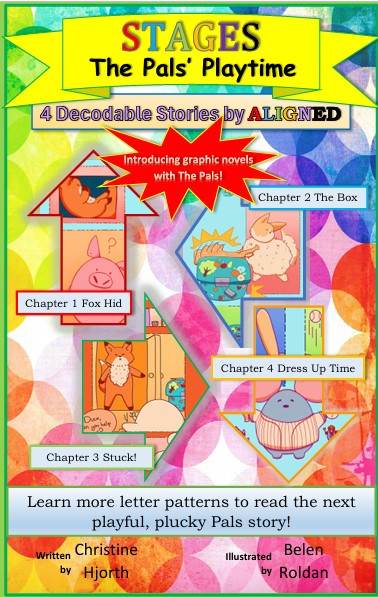 STAGES The Pals’ PlaytimePrice range: $12.00 through $45.00
 -
 STAGES Dogs!Price range: $12.00 through $45.00
 -
 STAGES Pat and Tim: Fun TimesPrice range: $12.00 through $45.00
 -
 STAGES Spiders!Price range: $12.00 through $45.00
Decodable Chapter Books
-
 Digraph Set – 18 TitlesPrice range: $100.00 through $485.00
 -
 Days with Piper: Beach Day! a Decodable Chapter Book$10.00
 -
 Days with Piper: Lake Time, a Decodable Chapter Book$10.00
 -
 The Day Out, a Decodable Chapter Book$10.00
STAGES Decodables by Aligned
What is “Decoding”?
Learning to read is like breaking a code.
Letters make sounds.
Put those sounds together and you decode the word. R A T
Change a letter and you make a new word. CAT
Add a letter and you make a new word. CATS
Rearrange the letters and you make another new word. CAST
“An essential part of the process for beginners involves learning the alphabetic system, that is, letter-sound correspondences and spelling patterns, and learning how to apply this knowledge in their reading. Systematic phonics instruction is a way of teaching reading that stresses the acquisition of letter-sound correspondences and their use to read and spell words (Harris & Hodges, 1995)” (National Reading Panel, 2001).
While learning new letter sounds/patterns, targeted practice is best!
What is “targeted practice” in reading instruction?
Targeted practice is taking the new sounds and inserting them into the code with letters/sounds the reader already knows. Not only does this help the reader learn the new sounds, but it strengthens their previously learned skills.
What are the benefits of “targeted practice” and how do they relate to the STAGES books?
There are three main benefits:
1. The Scaffolding Effect –
The cognitive load it takes to read the new texts is reduced when the student is practicing with already known letters/sounds and inserting the new letters/sounds into that knowledge.
“…the learner’s cognitive load is reduced with the aid of scaffolding and that this thus allows the learner to perform parts of a task that he or she would otherwise not be able to perform (va de Pol and Beishuizen, 2001).
What is “Cognitive Load Theory”?
“Cognitive Load Theory explains the way that we consider working memory while teaching complex concepts or solving problems. A higher cognitive load lowers the percentage of information that is stored in long term memory because you overwhelm your working memory” (Practical Psychology, 2023).
What is “scaffolding” in reading instruction?
The student would be unlikely to be successful if every letter in the words of books were unknown and/or new. By knowing some and adding some new ones, the student has support to practice the new sounds.
“Borrowed from the field of construction, where a scaffold is a temporary structure erected to help with the building or modification of another structure, the use of scaffolding as a metaphor within the domain of learning refers to the temporary support provided for the completion of a task that learners otherwise might not be able to complete.” (van de Pol and Beishuizen, 2001)
The STAGES books achieve this scaffolding effect in four chapters. Each chapter increases in difficulty by adding a few new sounds and high-frequency words. These sounds/words were chosen based on research of scope and sequences of 21 literacy curricula, and on the Science of Reading theory of introducing phonics skills from simplest to most complex.

By adding new sounds and including scaffolding of previously learned sounds, the student receives strong targeted practice.
2. The Confidence/Motivation Effect –
The reader builds confidence in their abilities by having success in slowly and steadily building their sound knowledge and decoding skills and applying them to new texts. This confidence builds motivation to learn more sounds and move forward towards harder and harder texts.
“Expectancy of success is more than a perception of general competence; it represents a future-oriented conviction that one can accomplish the anticipated task. If I do not believe I will be successful in accomplishing a task, I am unlikely to begin. Such beliefs can be both general (e.g. global self-concept) and specific (judgements of ability to learn a specific skill or topic).” (Cook and Artino, Jr., 2016)
How do the STAGES books motivate readers?
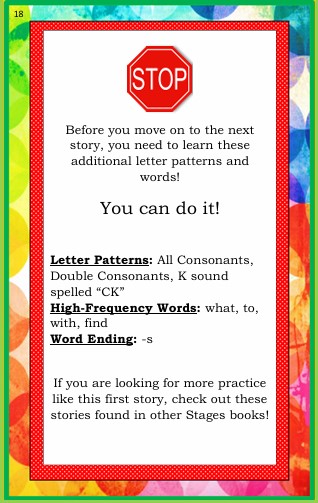
This is where the STAGES books shine! The student wants to read the next story. Therefore, they will work to learn the new sounds.
Success builds success!
“According to expectancy-value theorists, however, motivation requires more than just a conviction that I can succeed; I must also expect some immediate or future personal gain or value.” (Cook and Artino, Jr., 2016)
3. The Enjoyment/Engagement Effect –
The STAGES books will help to develop intrinsic motivation to read. The reader enjoys not only the feeling of success but also the stories, making them more likely to continue reading. Students with intrinsic motivation to read, such as the desire to read the next story in a STAGES book, are shown to be more fervent readers, and consequently more successful readers.
“Motivation and engagement play a crucial role in literacy development and achievement.” (Lee, Y., Jang, B. G., & Conradi Smith, K., 2021)
What is intrinsic motivation?
Intrinsic motivation is doing something because you are motivated by internal factors, such as a feeling of success or wanting to move to a higher skill level of a task. Extrinsic motivation is when the perceived benefit or value comes from the outside. For example, earning a sticker on a chart, or a “well done” from a teacher or parent.
“Intrinsic motivation to read comes from personal interest or enjoyment of reading and is related to positive experiences with reading itself. Studies have shown that intrinsic incentives, such as personal interest in the material, curiosity, involvement in the text, and a preference for challenge (e.g., McGeown et al., 2012) are better predictors of reading frequency and comprehension than extrinsic incentives, such as rewards or grades, parental pressure etc.” (Vogrinčič Čepič, Mascia, T. & Aerila, JA., 2024).
How do the STAGES books keep readers engaged to build intrinsic motivation?
As mentioned above, letters make sounds, sounds make words, and words have meaning. Change or rearrange the letters, and you make a new word with a new meaning.
Sentences are the same way. Words have meaning. Put those words into sentences in a specific order and the sentence has a meaning. Rearrange or change a word, and the sentence has a new meaning or no meaning at all.
The cat is big.
The cat is small. (different meaning)
The small is cat. (no meaning)
The STAGES books are formatted so that the reader needs to read the sentence(s) alone on the page, with no picture available that they could use as a clue to guess a word. They then turn the page to see the corresponding picture. This confirms the meaning of the sentence they just read.
However, this sentence-then-picture approach also builds engagement and entertainment. The reader reads the sentence and takes those words to build a picture in their mind of what they read. Sometimes the picture matches that picture (engagement), but sometimes they turn the page, and the picture shows an unexpected alternative to what they are thinking (entertainment).
Students who enjoy reading, and make it a regular part of their lives, are able to improve their reading skills through practice. Better readers tend to read more because they are more motivated to read, which, in turn, leads to improved vocabulary and comprehension skills (PISA 2018 Results, vol. II. ch. 8, OECD, 2020).
For example, in Story One in the book Pat and Tim: Fun Times, the page reads:
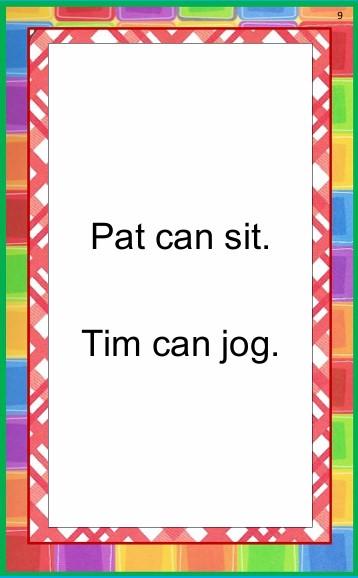
The reader may think they will see Pat sitting on a chair and Tim jogging in a park. But when they turn the page, this is the picture.

The STAGES books help your child learn how to read and to love reading, by providing targeted, real-world practice in stories that keep them engaged and motivated!